
 Book
| Open Access |
https://doi.org/10.37547/gbps-38
Book
| Open Access |
https://doi.org/10.37547/gbps-38
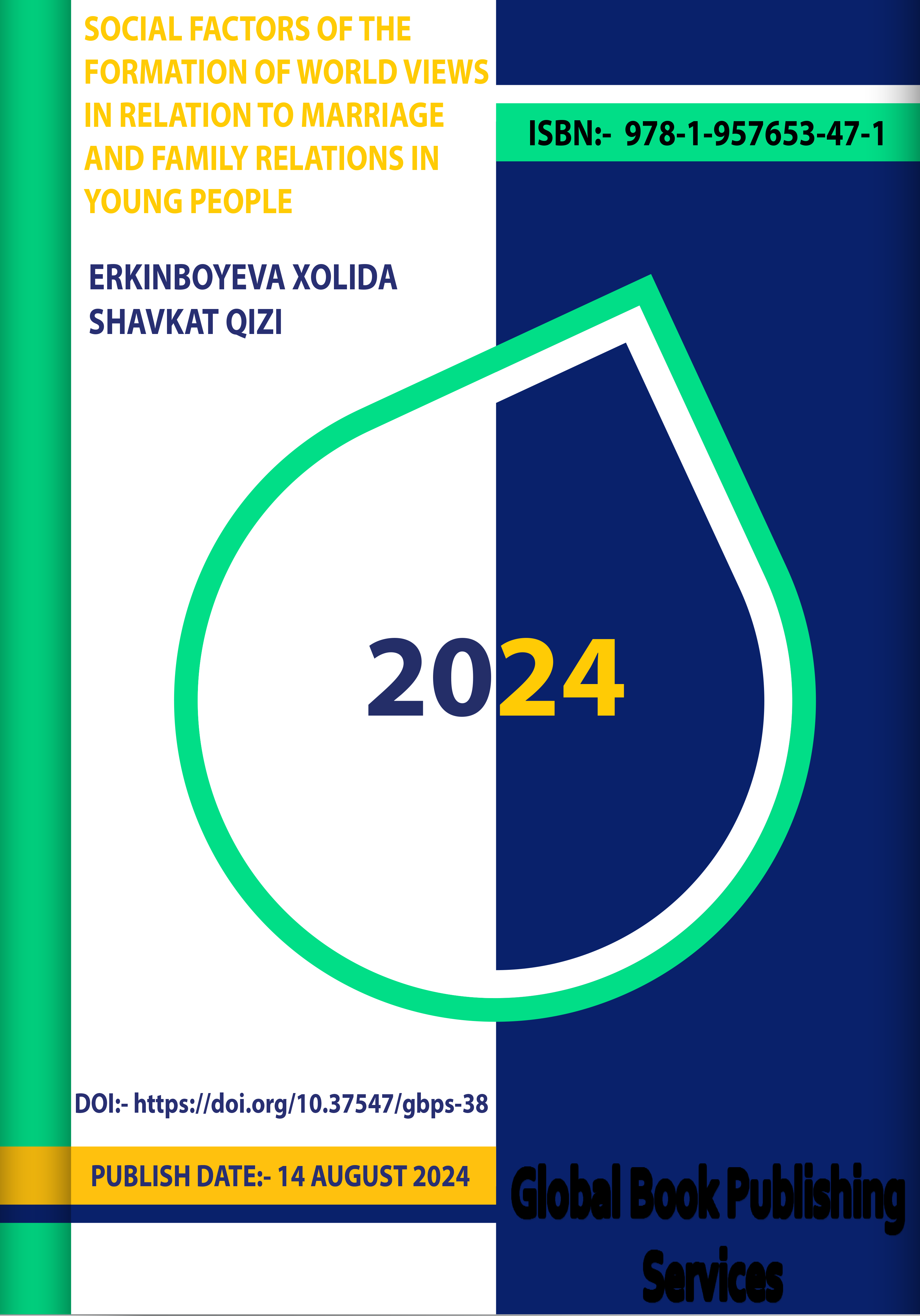
SOCIAL FACTORS OF THE FORMATION OF WORLDVIEWS IN RELATION TO MARRIAGE AND FAMILY RELATIONS IN YOUNG PEOPLE
Abstract
The institution of marriage and family has been a fundamental component of human society for millennia, serving as the primary unit of social organization, cultural continuity, and economic cooperation. Despite its enduring presence, the conceptualization and structure of marriage and family have never been static; they have evolved significantly in response to changing social, economic, and cultural conditions. In the contemporary world, particularly among young people, these changes are more pronounced than ever before.
Keywords
Worldviews, Relation To Marriage, Family Relations
References
Appadurai, A. (1996). Modernity at Large: Cultural Dimensions of Globalization. University of Minnesota Press.
Beck, U., & Beck-Gernsheim, E. (1995). The Normal Chaos of Love. Polity Press.
Becker, G. S. (1981). A Treatise on the Family. Harvard University Press.
Bourdieu, P. (1984). Distinction: A Social Critique of the Judgement of Taste. Harvard University Press.
Butler, J. (1990). Gender Trouble: Feminism and the Subversion of Identity. Routledge.
Collins, P. H. (2000). Black Feminist Thought: Knowledge, Consciousness, and the Politics of Empowerment. Routledge.
Connell, R. W. (1987). Gender and Power: Society, the Person, and Sexual Politics. Stanford University Press.
Durkheim, E. (1897). Suicide: A Study in Sociology. Free Press.
Esping-Andersen, G. (1990). The Three Worlds of Welfare Capitalism. Princeton University Press.
Giddens, A. (1992). The Transformation of Intimacy: Sexuality, Love, and Eroticism in Modern Societies. Stanford University Press.
Geertz, C. (1973). The Interpretation of Cultures: Selected Essays. Basic Books.
Gerson, K. (2009). The Unfinished Revolution: How a New Generation is Reshaping Family, Work, and Gender in America. Oxford University Press.
Hochschild, A. R. (1989). The Second Shift: Working Families and the Revolution at Home. Viking Penguin.
Inglehart, R., & Baker, W. E. (2000). Modernization, Cultural Change, and the Persistence of Traditional Values. American Sociological Review, 65(1), 19-51.
Lareau, A. (2003). Unequal Childhoods: Class, Race, and Family Life. University of California Press.
Robertson, R. (1992). Globalization: Social Theory and Global Culture. Sage Publications.
Stacey, J. (1996). In the Name of the Family: Rethinking Family Values in the Postmodern Age. Beacon Press.
Stone, P. (2007). Opting Out? Why Women Really Quit Careers and Head Home. University of California Press.
Turkle, S. (2011). Alone Together: Why We Expect More from Technology and Less from Each Other. Basic Books.
Journal Articles:
Arum, R., & Roska, J. (2011). Academically Adrift: Limited Learning on College Campuses. University of Chicago Press.
Blossfeld, H.-P., & Timm, A. (2003). Educational Systems as Marriage Markets in Modern Societies: A Conceptual Framework. European Sociological Review, 19(1), 1-15.
Brown, B. B., Bakken, J. P., & Burton, L. M. (2008). Peer Relationships and the Development of Individual Differences in Maturity. Journal of Adolescent Research, 23(1), 3-22.
Ellison, N. B., Steinfield, C., & Lampe, C. (2007). The Benefits of Facebook "Friends": Social Capital and College Students' Use of Online Social Network Sites. Journal of Computer-Mediated Communication, 12(4), 1143-1168.
Gerbner, G. (1969). Toward "Cultural Indicators": The Analysis of Mass Mediated Public Message Systems. AV Communication Review, 17(2), 137-148.
Kalmijn, M. (2013). The Influence of Men’s Income and Employment on Marriage and Cohabitation: Testing Oppenheimer’s Theory in Europe. European Journal of Population, 29(3), 259-290.
Lichter, D. T. (2012). Childbearing Among Cohabiting Women: Race, Pregnancy, and Union Transitions. Family Relations, 61(5), 714-728.
McLanahan, S. (2004). Diverging Destinies: How Children Are Faring Under the Second Demographic Transition. Demography, 41(4), 607-627.
McLanahan, S., & Percheski, C. (2008). Family Structure and the Reproduction of Inequalities. Annual Review of Sociology, 34, 257-276.
Mills, M. (2011). Introducing Survival and Event History Analysis. Sage Publications.
Morgan, M., Shanahan, J., & Signorielli, N. (2009). Growing Up with Television: Cultivation Processes. In J. Bryant & M. B. Oliver (Eds.), Media Effects: Advances in Theory and Research (pp. 34-49). Routledge.
Orloff, A. S. (1993). Gender and the Social Rights of Citizenship: The Comparative Analysis of Gender Relations and Welfare States. American Sociological Review, 58(3), 303-328.
Sobotka, T. (2004). Is Lowest-Low Fertility in Europe Explained by the Postponement of Childbearing? Population and Development Review, 30(2), 195-220.
Turkle, S. (2011). Alone Together: Why We Expect More from Technology and Less from Each Other. Basic Books.
Signorielli, N. (1993). Television and Adolescent Sexuality. Journal of Adolescent Health, 13(4), 285-291.
Weston, K. (1991). Families We Choose: Lesbians, Gays, Kinship. Columbia University Press.
Ward, L. M. (2002). Does Television Exposure Affect Emerging Adults' Attitudes and Assumptions About Sexual Relationships? Correlational and Experimental Confirmation. Journal of Youth and Adolescence, 31(1), 1-15.
Article Statistics
Downloads
Copyright License
Copyright (c) 2024 Erkinboyeva Xolida Shavkat Qizi

This work is licensed under a Creative Commons Attribution 4.0 International License.